This story begins with a very 21st-century theme and travels back in time to show that nothing much has changed.
It started with my stepfather’s suicide which precipitated my mother’s death less than two years later. In the dark days directly following my mother’s death my coping mechanisms included Adam Sandler movies, Jameson neat, The Pogues, and Ancestry.com.
I’d never had much interest in Ancestry.com before then; I honestly thought I knew everything I needed to know:
On my dad’s side, we go way back and I’m a member of the Elizabeth Warren band of the Cherokee tribe. I could join the Daughters of the American Revolution or the Daughters of the Confederacy, depending on my fancy (which would land on the former if I had to pick one because I’m an actual patriot.)
My mother’s side wasn’t so complicated: English and Danish, the end. Everyone just got here (in the late 19th century) and everyone was a farmer, nothing interesting to know.
What I found on Ancestry confirmed most of that, though my mom’s family went back a lot further on her mother’s side than her father’s - he was a first-generation America-Dane, that I quickly confirmed. My father’s side unfolded exactly as it had been related to me by my grandmother, and enough distant cousins were out there uploading pictures that I got a pretty good idea of where we all got this face.
Still, no amazing revelations or even a good clue as to who our Cherokee ancestry came from in the new names that revealed themselves with every click on a tiny, wiggling leaf. Regardless of the unexciting results, there was something comforting about drawing lines to my family members and making connections with people who were no longer here but maybe were with my mom. I spent hours and hours clicking on little leaves and pouring over scans of hundreds of hundred-years-old documents.
Two years after my mother’s death, as I was finally feeling like myself again having thrown myself head and heart first into Hillary Clinton’s campaign, the DNA tests came out. I rushed to get one that was $100 spent confirming everything I thought I knew except for the Danish which was conspicuously missing. But there were generic Scandy genes present overall and these things are imperfect as we know so I didn’t think much of it.
Fast forward several years and a few stolen SCOTUS seats and now we’re in the midst of a global pandemic. I order a 23andMe test because I hear they’ve got a tighter DNA game over there and I had already bought the Korean infrared-light facial mask, learned to embroider, attempted and abandoned gardening, and Marie Kondo’d the fuck out of my entire life several times over. Did not learn Spanish as planned. Did not get in amazing shape.
23andMe has an easy-to-understand family tree feature that shows anyone in your family who has also taken a test and made their results public. I jump in and see my dad’s sister’s kid - my first cousin, and a few people with family names I recognized on that side of my tree. On my mother’s side, there were only 2nd cousins with names I had never seen before.
I could go through all the steps that brought me to the realization that the alcoholic pedophile I thought was my mother’s father was not related to either one of us at all, but it’s not that exciting. The short version is that I got in touch with a distant cousin on 23andMe and she was able to direct me to our common relative and boom. I have a new family.
3 days later, I found New Grandpa and noodled out how my grandmother had likely met him in Great Falls, Montana the summer of 1945. That summer they both graduated from high school and were likely visiting grandparents there while Fake Grandpa was still busy taking Okinawa or something. It’s truly amazing how easy it was. Big ups to Ancestry.com for having literally all the receipts.
New Grandpa was a well-respected businessman from the other side of the state and by all accounts a really good guy, and good-looking guy in a midcentury leading man kind of way. It was suddenly very clear why my mother was Elizabeth Taylor-level gorgeous and whip-smart while her three younger sisters are basically potatoes.
I spent some time wondering how my mother’s life might have been different with this upstanding man and not the red-nosed-pedo-janitor as her father and continued browsing through the paternal line of New Grandpa, stopping at his grandparents.
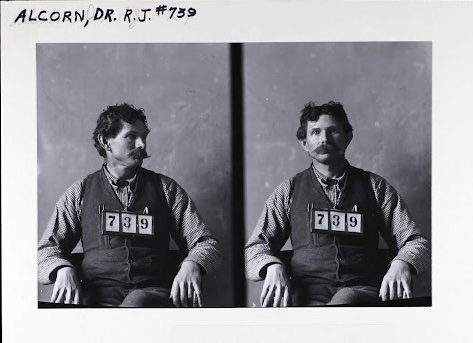
My great-great-grandparents were Dr. Reilly Jefferson Alcorn, MD, and Dr. Cora Elnora Hilton-Alcorn, MD. They were married in Lewiston, Montana in 1893 where they met at a teacher’s conference and married soon afterward.
They spent the next 6 or so years teaching in various logging and mining towns in Idaho and Montana while my grandfather pursued his MD and apparently did some gambling. Newspapers were full of tea back at the turn of the 19th century; whether you had a fever, a visitor, or bad debt - your local paper was bound to cover it.
It's clear that my grandfather practiced some unlicensed medicine before getting his degree, which may or may not have been kosher, but I’m sure that the people who received his care were happy to get it in Northern Idaho circa 1890. I’m going to guess that the majority of the care he provided had to do with mending broken bones, healing burns, resolving STDs, and likely terminating pregnancies - because right behind any new logging or mining concern that popped up came its companion brothel.
During the time my grandfather was working toward his MD, my grandmother was following close behind - she just had to give birth to my great-grandfather and get him walking and able to semi-feed himself (or at least not depend on her body for sustenance) while also teaching school and moving every few months (to run away from unpaid debts it would seem.) New GG Grandma was clearly a long-suffering, eyes-on-the-prize kinda lady.
People probably thought she was bossy.
In the summer of 1899, while my grandmother was away in Kansas finishing her MD (with my 3-year-old great-grandfather in tow) my grandfather was living in Harrison, Idaho. One night a young woman named Cora Burke came to him having attempted to terminate her pregnancy with an 1899-style hairpin, the sort with which one could stick 5 feet and 30 pounds of hair neatly on top of one’s head. Such implements generally had rubber covers over the ends, as their modern-day versions do, and while it’s hard to tell from all the sources I have found if Cora was able to successfully extract the fetus she was carrying, it is clear that she left behind one of the rubber covers.
In any event, she came to my grandfather with the termination underway. Whether his role was to help her complete the termination or to treat the hairpin-induced infection that caused the sepsis that eventually killed her isn’t clear. What is clear is that my grandfather seemed to know how the death of Miss Burke would reflect on him. He fled to Montana where he was captured a couple of weeks later and hauled back to Boise where he would stand trial for performing an “illegal operation” which resulted in the death of his patient.
After two trials, one resulting in a hung jury and the other finding him guilty of manslaughter, Dr. Alcorn would be sentenced to a seven-year stint in Idaho State Prison. He would appeal his sentence on habeas corpus and lose (he was charged with murder and found guilty of manslaughter which was not prescribed as a possible verdict in the underlying law,) he would appeal on a technicality around the date on which he allegedly performed the “illegal operation” and lose. The judge in the second appeal had a particularly fiery rebuttal to the defense’s claim:
“The crime for which the appellants.issiii has been convicted is one of the worst known to the law. An unnatural abortion brought about using a drug or instruments violates the decency, the best interests of society, the divine law, the laws of nature, and the criminal statutes of this state and is not only destructive to the life of the unborn but places in jeopardy the life of the human being.”
I gotta stop right here and have us all marinate on the clear delineation the judge makes between the humanness of the mother and the “unborn.” And… yep, that does seem to be an admission. There’s only ever one human being in the equation - in this, as with every case, she was the only one with any real skin in the game and she lost and my grandfather lost 4 years of his life behind bars trying to help her.
Miss Cora Burke was born a loser in the century before last, she and every other woman who wanted to maintain any sort of physical autonomy. Doctors like my grandfather risked and lost their freedom to help them - sometimes even their lives in the process.
From 1972 to 2022 women enjoyed 50 glorious years of autonomy where their lives, bodies, and very futures were left to their decision-making. We were the humans in the scenario, without question.
Today in Idaho abortion is completely banned, the only exceptions being:
- When the life of the mother is in imminent danger. Idaho requires an “affirmative defense,” meaning a provider has to prove in court that an abortion met the criteria for this singular legal exception. In other words, Ms. Cora Burke would probably still die - even with all the modern magic we have today because my GG grandfather would have had to go to court to get PERMISSION to save her life. How long does that take? Can you haul a judge out of bed for that?
- Rape or incest. This must be proven in a court of law before performing the abortion. Again - how long does this take? I’m not even going to bother with the part where women often don’t report these things. And incest? My mom didn’t deal with that trauma in her life until she was almost 40 years old.
My grandfather was the kind of guy who would have risked it, knowing providing care was a matter of life or death, after all he tried to save Ms. Burke at the cost of his freedom. Maybe the 2024 version of his case will be the one that finally shows the world how sick, inhumane, anti-science, and perverted a policy it is to allow legislators and judges to make healthcare decisions for women.
We’ll have to wait and see.