Vile Evil
Vile Evil
Vile men ruling us
While we sit on our sad hands
Who owns this evil?


Vile men ruling us
While we sit on our sad hands
Who owns this evil?
It was another lovely late spring evening and R.J. was just settling into his evening slice of apple pie and a cold glass of milk when Mrs. Burke came rushing into the saloon.
“Oh thank the good Lord, Doctor Alcorn, there you are.” Mrs. Burke said, catching her breath and attempting to appear collected (she was a mess.)
“I need your assistance at once, will you come with me please?” R.J. could see that she had been crying and was even more slight than ever.
Poor woman, he thought to himself. I shall have to tend to her as well.
“Lead the way, ma’am.” R.J. left his evening nosh and followed Mrs. Burke into the waiting carriage outside where Miss Cora Burke was not totally conscious and profusely sweating.
“She passed the baby the day after we saw you…I was so grateful to God that he saw fit to release her from her imminent shame…she didn’t stop bleeding right away, I have lost children at that stage myself and knew it to be a normal occurrence. But the following day she became feverish and retreated to her bed again. She's been getting worse for the past two days, doctor. I don’t know how to help her, please, Dr. Alcorn, please help my sweet girl….” Mrs. Burke spoke in a desperate, hushed whisper.
R.J. felt the young woman’s forehead and immediately knew she was the victim of an infection that would take her life. I must keep my composure, he thought to himself, taking a deep breath before turning his gaze to her mother.
“It’s alright, Mrs. Burke. Let’s get to my office with all haste.” R.J. knocked twice on the top of the cab and directed the driver to his office at the other end of Main Street.
The two were barely able to rouse Miss Burke and struggled to get her out of the cab and into Dr. Alcorn’s office, to any onlookers the sight would have been odd to say the least.
Once in the examination room, they were able to get Cora onto the table. Her skin was waxy and covered in a cold sweat as her body fought to relieve her from the inferno the infection was forging.
“Bend her legs for me, will you - and hold them open,” R.J. instructed, Mrs. Burke did as she was bid immediately as R.J. produced a speculum from a drawer and disappeared under Miss Burke’s skirts.
“There’s no persistent bleeding, that’s a good sign, but with this fever I suspect there is remaining fetal tissue in her uterus. I shall do my best to remove it, but I have to warn you that the sort of infection that results from such an occurrence is famously… unresolvable.” R.J. again heard himself.
Too cold, he thought, though he felt the full terror this woman was experiencing quite acutely.
Mrs. Burke burst into tears, “I would have brought her to you sooner sir, I just didn’t know how to do that without Mr. Burke discovering us, I had to wait until he left this evening to visit his sister. What have I done?” she sobbed.
R.J. held a lantern as he peered into Cora’s body. “Mrs. Burke, you said the baby passed by the grace of God himself and not by any of your own intervention, is that correct?”
“Yes, Cora came to me on Wednesday and told me that she was bleeding and could not stop it. I helped her to bed and stayed with her until it subsided, she passed a large amount of blood and other matter.” Mrs. Burke responded, suddenly quite calm.
“I just see some tearing around the opening to her womb, ma’am,” R.J. said delicately. “It may be that she took actions without telling you, I’m sorry to say.”
Just then Cora moaned, “Mama?”
“I’m right here, darling girl. Mama is right here.” Mrs. Burke whispered in her ear.
“Miss Burke, did you remove the fetus from your womb with some sort of apparatus? Please, dear, you must tell me.” pleaded Dr. Alcorn.
Cora again loses consciousness and seems to seize.
“What’s happening?!” Mrs. Burke shrieked
“Please, madam. We must not cause alarm lest we draw attention to ourselves.” whispered Dr. Alcorn. “Please attempt to hold her steady while I take a closer look.”
Mrs. Burke did as she was bid and Dr. Alcorn again disappeared into Cora skirts. A few seconds later he appeared with a tweezer holding an oblong black object.
“Do you have any notion of what this might be?” R.J. asked.
Mrs. Burke looked closely at the item. “Could it be the end from a hairpin?”
Dr. Alcorn retrieved a magnifying glass from his desk and looked harder yet, bringing the item close to the gas light. “I think you may be correct.”
“In this case I think we can gather that your daughter aborted this fetus using a hairpin.” Dr. Alcorn stated matter of factly. “It is my belief that she not only left behind fetal tissue, but clearly the rubber hair pin cover which I imagine was covered with germs and bacteria as your daughter likely is not up to date on germ theory….” His voice trailed off as he saw Mrs. Burke’s expression turn from fear to despair.
“I’m so sorry, Mrs. Burke. But your daughter has contracted an infection from her efforts to free herself of her burden. And there is no cure for such an infection. I’m so sorry….”
The woman began to wail a deep guttural sound R.J had. heard before. It’s a very unique tone, he’d recognize it anywhere as the sound of a mother losing her child. She was wracked with sobs as she fell to her knees and began to wind herself into a shell on the floor, pounding her head against the polished wooden floorboards in time with her keening,
“My dear lady, please stop,” R.J. begged. He lifted Mrs. Burke to a chair before returning to Cora on the table, relaxing her legs and making sure she was properly covered.
“There, there.” R.J. did his best to soothe her grief, but what was there to do? He had to help her cover the nature of her daughter’s passing and that meant getting the girl out of his office before God took her. “I’ll be right back, Mrs. Burke. Please spend this time with your daughter.”
R.J. exited the office through the backdoor and hurried down the sidestreet where he found a cab for hire and slipped the driver a sack of coins, “Please take me behind Burke’s Haberdashery.”
Moments later R.J. was back inside the office, shuttling Mrs. Burke out the backdoor and into the cab as he and the driver carried Cora from the examination table, out the door behind her.
“Delivery these ladies home and help Mrs. Burke put her daughter into bed.” R.J. instructed the driver and sent mother and daughter into the night, acutely feeling the coming pain of the former and lamenting the senseless loss of the latter.
The next morning R.J. arrived at the undertaker early to report the sad news of Miss Cora Burke’s untimely passing from a fever and then went about his day.
Mrs. Burke returned with her daughter shortly after 11 o’clock that night. After a short examination to which Mrs. Burke was a witness, Alcorn found that Cora was past the point of no return, not much, but still too far gone to safely remove the fetus from her uterus. Far past the time that the herbs he had learned about from a local Chinese healer would do the trick.
“Miss Burke, I am sorry you have found yourself in this predicament. I am aware that members of my sex can be truly evil when it comes to carnal sins, telling young women whatever they think they want to hear in order to accomplish what they believe to be a coup. On behalf of my kind I apologize. I regret to tell you that you have progressed too far in the gestation of this fetus to safely terminate the pregnancy.”
“But doctor,” Mrs. Burke immediately protested,”How can that possibly be the case? I had heard you were able to help a young woman from the camp with her problem and surely Cora has only missed one cycle. How can that be?” She very clearly was terrified.
“I do apologize and I am sympathetic to your daughter’s plight, but I would guess that your daughter has missed at least three cycles if not four,” he turned to Cora, “Isn’t that right, Miss Burke?”
Cora Burke just stared at her toes as they dangled over the side of the table, her shift waving a little with the breeze created by her mother’s rapid fanning. She nodded.
“I might suggest tracking down the young man responsible for your condition, Miss Burke. I trust you know something about him other than his name?”
Miss Burke did not answer.
R.J. hoped the girl did. He had seen a great many young ladies in this condition in these first years of his medical practice. He knew the best this girl could hope for is a wedding day. And very soon. And she might want to move to another town anyway.
As if she could hear R.J.’s thoughts, Mrs. Burke fell to pieces in the middle of the examination room floor, her frail body wracked with sobs as Cora Burke stared straight ahead.
No tears, barely an expression at all. Her dark brown eyes suddenly closed and she said without changing her expression in the slightest: “The man responsible for this is not a man I would or could want to marry, the way I became to be in the family way had nothing to do with love or what family should be made of. It was violence, doctor. Please, sir, I beg of you - what exactly is the risk? You ask me to carry a child that was given to me by the acts of a violent man.”
“My dear, I am truly sorry that I can not help you, more so now that you have revealed the author of your unfortuitous situation.” R.J. heard it only when there was no time to undo it. This was so often the case with his mouth.
“UNFORTUITOUS??” Mrs. Burke suddenly sprang back to life and was all business, on her feet with her chest held out as if she was ready for a fight.
“I do apologize, ma’am and madame. I realize that my choice of words was clumsy at best and heartless at worst.” R.J. wasn’t the kind of man to be offended by a woman expressing her strength - and, as was mentioned, he had heard it and regretted it as he had said it. He was always willing to admit when he was wrong - how, in fact, could one be a scientist of any worth at all if one is not willing to admit one’s mistakes?
The women seemed satisfied with R.J. 's offering of atonement, having made the emotional transference from outrage to humility in a breath.
“Thank you for seeing me, doctor.” Cora said steadily as she gathered herself to leave.
“I only hope the best outcome for you and your child, Ms. Burke. Please let me know if there is anything I can do to be of assistance, anything at all.” R.J. said, dropping any pretense of Cora being a child.
The two women departed Doctor Alcorn’s office by the back entrance and hurried to the same cab that brought them, paid to wait as long as needed and longer.
But this as far as his involvement with Miss Burke would go. He must try to put her predicament out of his mind, the ability to keep his rather big heart out of things was his biggest challenge as a physician.
He bid the two women goodnight, closed up his office and strolled down main street to the saloon on the other end of town for his supper and perhaps a game of cards, who knew what the night would bring? He was a bachelor for the time being. His beautiful, smart wife in St. Joseph Missouri, just months away from becoming a doctor herself. She had just departed for the fall term with their son, Argie, who would be watched by the kind woman from which Cora rented her rooms while she attended seminars.
They were truly lucky, he thought to himself, for so many things, not least of which the people they came across together. They’d been married almost 7-years and he never regretted it for a moment, though many doubted the strength of their union. They had met at a teachers conference in Lewiston, Montana. Cora, just 23 years old, living with her sister in Butte and hoping to obtain a teaching position through her attendance at the conference that spring. Their meeting had been filled with the kind of love at first sight magic Cora said she had read about in dime store novels. They were married just 3-months later, a whirlwind of sapiosexual rapture.
R.J. sighed to himself as he entered though the saloon's swinging doors and left the sweet spring air for the smell of smoke and humans. It would be a lonely few months without Cora and Argie, who was beginning to be such a grand, if not a slightly insane, little person. Three year old humans sure are something. Argie’s ability to reason was nowhere to be found, but his ability to charm the pants off of anyone he met was way above average, R.J. suspected. And such a handsome little chap, he mused as he took his seat at a table.
The barkeep was a young German man who had recently made his way across the country from Baltimore, Christof Reinekei. A cheerful young man, always whistling a familiar, chipper tune R.J. could never place but enjoyed nonetheless. Christof greeted R.J. with a tip of his hat and walked over to his table,
“Guten abend, Doktor,” Christof placed a napkin on the doctor's lap for him, doing his best to earn the tip that were his only wages at this job, that and room and board he felt quite lucky to have. It gave him time to work his small quartz claim by day, a gamble he had invested all his Baltimore family’s savings into.
“Can I get you a steak and a nice drink of something brown in color?” Christof joked, knowing the doctor was a teetotaling vegetarian.
“That you can, Herr Reineke, just milk and a piece of that pie if there’s still any left.”
“Coming right up, Herr Alcorn!”
“Doktor!” R.J. retorted with a chuckle.
Dr. R.J. Alcorn walked briskly down Main Street to the office next to Burke’s Haberdashery that he shared with Dr. Gerald Stackhouse, who specialized in diseases of the ear, nose, and throat. He enjoyed quite a brisk business attending to the miners, who inhaled all manner of dust and bugs and Lord knows what else as they dredged the mountainsides in hopes of uncovering a fortune hidden beneath layers of earth.
As for Dr. Alcorn, he specialized in broken bones, sprained joints, fevers, and ailments of a venereal nature. There was a roaring market for such things, thanks to those same camps. Dr. R.J. was more than happy to be one of the few doctors who would venture out to far-flung places like Harrison. Boomtowns like this had made for a good living and allowed him and his wife, Cora, to teach the local children in addition to offering medical services.
Unfortunately for Dr. Alcorn, his healing services were not always appreciated by the spouses of those who received them. He was often seen as a purveyor of vice by local clergy due to his ability to relieve sinners from the wrath they had surely incurred from God. A way was usually found to run him out of town, most often through a slanderous article in the local newspaper and gossip whispered in church pews—pews one never found Dr. Alcorn in. That was no help to him at all, but R.J. was a man of science and one who enjoyed the calm of a lone Sunday morning.
“Good morning, Mr. Burke,” Dr. Alcorn sang to the portly, graying man sweeping the walk in front of the haberdashery.
“Good morning to you, Dr. Alcorn,” Burke replied as Dr. Alcorn unlocked the door to a modest storefront painted with a shiny white coat that made it seem as though the filth of the outside stopped abruptly at its threshold.
Inside, Dr. Alcorn took off his hat and settled behind his desk with The Mountain Messenger. He was finishing the front page, which had been obnoxiously cluttered with advertisements intermingled with the real news, so that one wasn’t quite sure where the news of electrification ended and advertisements for electrical appliances began.
This can’t be good for the everyman’s conception of reality, Dr. Alcorn thought, just before there was a knock at the door.
He looked up to see Mrs. Burke, the wife of his neighbor in commerce, waving at him through the glass door. He motioned for her to come in.
“Lovely morning, isn’t it, Dr. Alcorn?” Mrs. Burke began, which tipped Dr. Alcorn off to the fact that she wasn’t there for some typical ailment. When a woman of Mrs. Burke’s age came to see him, it generally ended in a bottle of laudanum. There just wasn’t much else to do for women of a certain age but help them cope with the fact that they were no longer of use to society—sad as it might be. At any rate, the approach was generally direct in such cases; there was never any mention of the weather.
“You are certainly correct, ma’am. It is quite lovely. And how can I be of assistance to you?”
Dr. Alcorn wasn’t one for spending time on things he didn’t enjoy, and he didn’t enjoy small talk.
“Oh, well, I certainly didn’t want to take up any of your valuable time, Doctor,” replied Mrs. Burke with a glance at the newspaper on his desk. “I just had a question to ask of you. It’s of a very delicate nature, and I must know that I can trust you will keep my confidence about this matter.”
This can be one of only a few things:
“You can trust me absolutely, madam—as though I were your clergyman, perhaps more,” Dr. Alcorn quipped as he walked to the door and pulled the shade. “We’ll make sure no one walks in on our conversation as an added precaution.”
He pushed the slide latch closed and gestured to Mrs. Burke to take a seat.
Mrs. Burke sat at the edge of the chair, her pocketbook held tightly in her hands.
“It’s my daughter, Dr. Alcorn,” she began.
Ah. The final of the three possibilities.
R.J. kept his gaze steady and softened his eyes. He could see the torment the poor woman was experiencing. She was slight to begin with, but it was clear she had not been eating or sleeping. Dark circles under her eyes and hollows in her usually rosy cheeks betrayed her stress.
Mrs. Burke paused, took a deep breath, and continued.
“It seems that she has found herself in the family way, and the young man responsible has disappeared from the area. Her father does not know anything of her troubles, so please, Dr. Alcorn—please keep the subject of my visit from him.”
“Again, Mrs. Burke, you can be sure that I will keep your confidence at all costs,” he replied gently. “Does Miss Burke have an idea of when this came to pass? In other words, how far along would you say your daughter is?”
“Cora told me that she missed her cycle just last week,” Mrs. Burke replied.
“Ah, Cora, you say. That’s my wife’s name as well. She’s currently away in Missouri completing her medical studies—with our three-year-old son, if you can believe it.”
He quickly realized this did nothing to comfort Mrs. Burke and returned to the matter at hand.
“Please bring her to me this evening, and I will examine her.”
This story begins with a very 21st-century theme and travels back in time to show that nothing much has changed.
It started with my stepfather’s suicide which precipitated my mother’s death less than two years later. In the dark days directly following my mother’s death my coping mechanisms included Adam Sandler movies, Jameson neat, The Pogues, and Ancestry.com.
I’d never had much interest in Ancestry.com before then; I honestly thought I knew everything I needed to know:
On my dad’s side, we go way back and I’m a member of the Elizabeth Warren band of the Cherokee tribe. I could join the Daughters of the American Revolution or the Daughters of the Confederacy, depending on my fancy (which would land on the former if I had to pick one because I’m an actual patriot.)
My mother’s side wasn’t so complicated: English and Danish, the end. Everyone just got here (in the late 19th century) and everyone was a farmer, nothing interesting to know.
What I found on Ancestry confirmed most of that, though my mom’s family went back a lot further on her mother’s side than her father’s - he was a first-generation America-Dane, that I quickly confirmed. My father’s side unfolded exactly as it had been related to me by my grandmother, and enough distant cousins were out there uploading pictures that I got a pretty good idea of where we all got this face.
Still, no amazing revelations or even a good clue as to who our Cherokee ancestry came from in the new names that revealed themselves with every click on a tiny, wiggling leaf. Regardless of the unexciting results, there was something comforting about drawing lines to my family members and making connections with people who were no longer here but maybe were with my mom. I spent hours and hours clicking on little leaves and pouring over scans of hundreds of hundred-years-old documents.
Two years after my mother’s death, as I was finally feeling like myself again having thrown myself head and heart first into Hillary Clinton’s campaign, the DNA tests came out. I rushed to get one that was $100 spent confirming everything I thought I knew except for the Danish which was conspicuously missing. But there were generic Scandy genes present overall and these things are imperfect as we know so I didn’t think much of it.
Fast forward several years and a few stolen SCOTUS seats and now we’re in the midst of a global pandemic. I order a 23andMe test because I hear they’ve got a tighter DNA game over there and I had already bought the Korean infrared-light facial mask, learned to embroider, attempted and abandoned gardening, and Marie Kondo’d the fuck out of my entire life several times over. Did not learn Spanish as planned. Did not get in amazing shape.
23andMe has an easy-to-understand family tree feature that shows anyone in your family who has also taken a test and made their results public. I jump in and see my dad’s sister’s kid - my first cousin, and a few people with family names I recognized on that side of my tree. On my mother’s side, there were only 2nd cousins with names I had never seen before.
I could go through all the steps that brought me to the realization that the alcoholic pedophile I thought was my mother’s father was not related to either one of us at all, but it’s not that exciting. The short version is that I got in touch with a distant cousin on 23andMe and she was able to direct me to our common relative and boom. I have a new family.
3 days later, I found New Grandpa and noodled out how my grandmother had likely met him in Great Falls, Montana the summer of 1945. That summer they both graduated from high school and were likely visiting grandparents there while Fake Grandpa was still busy taking Okinawa or something. It’s truly amazing how easy it was. Big ups to Ancestry.com for having literally all the receipts.
New Grandpa was a well-respected businessman from the other side of the state and by all accounts a really good guy, and good-looking guy in a midcentury leading man kind of way. It was suddenly very clear why my mother was Elizabeth Taylor-level gorgeous and whip-smart while her three younger sisters are basically potatoes.
I spent some time wondering how my mother’s life might have been different with this upstanding man and not the red-nosed-pedo-janitor as her father and continued browsing through the paternal line of New Grandpa, stopping at his grandparents.
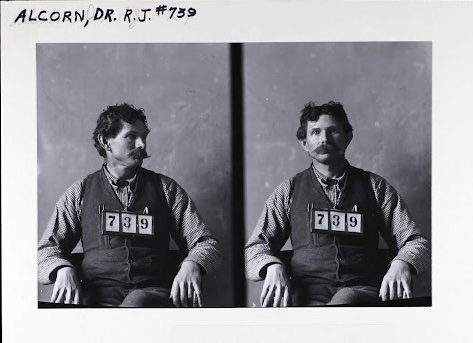
My great-great-grandparents were Dr. Reilly Jefferson Alcorn, MD, and Dr. Cora Elnora Hilton-Alcorn, MD. They were married in Lewiston, Montana in 1893 where they met at a teacher’s conference and married soon afterward.
They spent the next 6 or so years teaching in various logging and mining towns in Idaho and Montana while my grandfather pursued his MD and apparently did some gambling. Newspapers were full of tea back at the turn of the 19th century; whether you had a fever, a visitor, or bad debt - your local paper was bound to cover it.
It's clear that my grandfather practiced some unlicensed medicine before getting his degree, which may or may not have been kosher, but I’m sure that the people who received his care were happy to get it in Northern Idaho circa 1890. I’m going to guess that the majority of the care he provided had to do with mending broken bones, healing burns, resolving STDs, and likely terminating pregnancies - because right behind any new logging or mining concern that popped up came its companion brothel.
During the time my grandfather was working toward his MD, my grandmother was following close behind - she just had to give birth to my great-grandfather and get him walking and able to semi-feed himself (or at least not depend on her body for sustenance) while also teaching school and moving every few months (to run away from unpaid debts it would seem.) New GG Grandma was clearly a long-suffering, eyes-on-the-prize kinda lady.
People probably thought she was bossy.
In the summer of 1899, while my grandmother was away in Kansas finishing her MD (with my 3-year-old great-grandfather in tow) my grandfather was living in Harrison, Idaho. One night a young woman named Cora Burke came to him having attempted to terminate her pregnancy with an 1899-style hairpin, the sort with which one could stick 5 feet and 30 pounds of hair neatly on top of one’s head. Such implements generally had rubber covers over the ends, as their modern-day versions do, and while it’s hard to tell from all the sources I have found if Cora was able to successfully extract the fetus she was carrying, it is clear that she left behind one of the rubber covers.
In any event, she came to my grandfather with the termination underway. Whether his role was to help her complete the termination or to treat the hairpin-induced infection that caused the sepsis that eventually killed her isn’t clear. What is clear is that my grandfather seemed to know how the death of Miss Burke would reflect on him. He fled to Montana where he was captured a couple of weeks later and hauled back to Boise where he would stand trial for performing an “illegal operation” which resulted in the death of his patient.
After two trials, one resulting in a hung jury and the other finding him guilty of manslaughter, Dr. Alcorn would be sentenced to a seven-year stint in Idaho State Prison. He would appeal his sentence on habeas corpus and lose (he was charged with murder and found guilty of manslaughter which was not prescribed as a possible verdict in the underlying law,) he would appeal on a technicality around the date on which he allegedly performed the “illegal operation” and lose. The judge in the second appeal had a particularly fiery rebuttal to the defense’s claim:
“The crime for which the appellants.issiii has been convicted is one of the worst known to the law. An unnatural abortion brought about using a drug or instruments violates the decency, the best interests of society, the divine law, the laws of nature, and the criminal statutes of this state and is not only destructive to the life of the unborn but places in jeopardy the life of the human being.”
I gotta stop right here and have us all marinate on the clear delineation the judge makes between the humanness of the mother and the “unborn.” And… yep, that does seem to be an admission. There’s only ever one human being in the equation - in this, as with every case, she was the only one with any real skin in the game and she lost and my grandfather lost 4 years of his life behind bars trying to help her.
Miss Cora Burke was born a loser in the century before last, she and every other woman who wanted to maintain any sort of physical autonomy. Doctors like my grandfather risked and lost their freedom to help them - sometimes even their lives in the process.
From 1972 to 2022 women enjoyed 50 glorious years of autonomy where their lives, bodies, and very futures were left to their decision-making. We were the humans in the scenario, without question.
Today in Idaho abortion is completely banned, the only exceptions being:
My grandfather was the kind of guy who would have risked it, knowing providing care was a matter of life or death, after all he tried to save Ms. Burke at the cost of his freedom. Maybe the 2024 version of his case will be the one that finally shows the world how sick, inhumane, anti-science, and perverted a policy it is to allow legislators and judges to make healthcare decisions for women.
We’ll have to wait and see.
Dr. R. J. Alcorn was a frontier-era physician practicing in the American West around the turn of the 20th century, a time when medicine was as improvisational as it was essential. Working in mining towns and remote communities, he treated everything from respiratory ailments caused by dust-filled air to injuries sustained in dangerous labor conditions. Physicians like Alcorn often operated with limited resources, serving as surgeons, general practitioners, and pharmacists all at once.
Alcorn’s career reflects both the necessity and ambiguity of medical practice in that era. With few regulatory standards and immense public need, doctors were judged as much by their outcomes as by their methods. While details of his life remain fragmentary, he stands as a representative figure of early Western medicine—resourceful, resilient, and navigating a profession still defining its ethical and scientific boundaries.
He was my great-great grandfather.